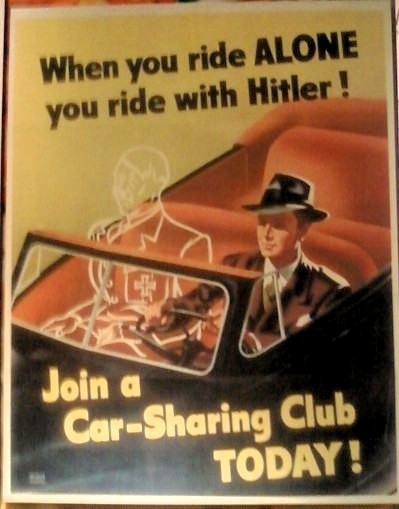
While visiting a museum I came across a poster from the time of the Second World War (see here). In it, a dashing man fully-formed sits in his cabriolet coupe next to the outline of Adolf Hitler. Across the top the poster reads: When you ride ALONE you ride with Hitler! Across the bottom it says: Join a Car-Sharing Club Today! In an age when the needs of the many tended to outweigh the needs of the few, when sacrifice and diligence and cooperation tended to trump convenience and wastefulness and selfishness, this poster probably have changed a few minds or convinced a handful of housewives to pool and conserve their resources. How, though, would such a poster work today? Would replacing Hitler with the outline of a religiously extremist Central Asian in turban and Kalashnikov (instead of the hardcore, genocidal Teuton in iron cross and side-part) convince today's Americans to understand that every gallon of Saudi Arabian gasoline they burn in their vehicles supports terrorism worldwide (see here & here)? I believe it is possible to win hearts and minds by using a slogan such as this: When you ride ALONE you finance Al Qaeda. I believe that if more people realized that America's addiction to combustible petrochemicals is her glaring, fatal Achilles heel, and if more people actively and consciously fought this addiction, we could move into a phase of human evolution marked not by death and pollution and destruction but by compassion and bounty and cooperation. So long, however, as we stay addicted to gasoline, as we keep driving alone, as we keep believing in the myth of American exceptionalism, as we keep voting for politicians who sell out to corporate interests, as we keep rejoicing at the subjugation and destruction of foreign lands by our military, and as we overdose on television we Ynki shall remain what we have become – a sea-anchor tearing apart the fragile structure of our common tender humanity. America delenda est.
© americanifesto / 場黑麥
Showing posts with label terrorism. Show all posts
Showing posts with label terrorism. Show all posts
16 October 2013

15 March 2013
interstate bicycle pathways
In the middle of the last century, American President Dwight D. Eisenhower envisioned a highway system ambitious in both scope and design. It pioneered new techniques (the clover-leaf interchange), spawned new ways of living (the suburb), and provided wanderlustig individuals with a relatively cheap method of traveling for both business and pleasure. But every silver lining has its cloud, and, today, Americans' dependence on petrol-carbohydrates is destroying the environment and helping to fund terrorism around the world. If we expect to keep breathing air and fitting into our jeans, we need to utilize a time-tested and reliable device largely ignored since the beginning of the automobile age: the bicycle.
Imagine ribbons of road stretching from Boston to Miami and from New York to Los Angeles, roads designed and built exclusively for bicycles. Imagine being able to bicycle to work each day without having to worry about getting sucked into the wake of a passing semi-truck. Imagine saving money and losing weight while pedaling a bicycle instead of spending money and getting fat while sitting in a car. The automobile isn't called the slave's chariot for nothing – it demands of its user ever and ever greater sacrifices without doing much to improve his financial or physical health or that of the environment. This author has been bicycling instead of driving for the past ten months in a town built around the car, and even though he contends daily with individuals who will pass him in the breakdown lane so that they can be the first in line at the next red light, he still feels sympathy for the poor fools who willingly trap themselves in mobile prisons of glass and steel.
Prosperity through sacrifice! Safety through knowledge! Happiness through exertion! These are the slogans that will drum up support for America's interstate bicycle pathways (IBP). Not only will the IBP create new manufacturing and service jobs in communities around the country (think of all those bikes breaking down and getting flat tires), it will cut this country's reliance on dirty, sadness-inducing oil and gas products. Furthermore, new developments in battery technology as well as cheaper and more efficient solar panels have prompted bike makers to equip velocipedes with electric motors for help on hills and super-efficient coasting. The author is not calling for the construction of an entirely new web of roads spanning from coast to coast, merely that the bike trails that already exist be linked to one another with dedicated, bicycle-only riding paths. In the Netherlands, roughly 27% of all trips are done on bicycle, whereas in the United States of America, less than 5% are. Difficulties of comparison aside, bicycling is a viable form of transportation even in places where the winters are harsh and the North Sea winds are strong. For the past year, the author has dreamed about being able to bicycle into Philadelphia from his house nearly a hundred miles away, but the most direct route – 30, the Lincoln Highway – is a traffic-choked road that was not designed to handle both driver and velocipedist. Adding insult to injury, the nearest commercial bus station lies more than twenty miles from his front door, and the most efficient method for reaching it is on a road even narrower and less bicycle-friendly than Route 30. Some day, fellow pedal-mashers, we will convince the slave's charioteers of the error of their ways, and get everyone back on the saddle. Until then, however, keep your clothes tight, your eyes and ears open, and your head on a swivel. Mahalo.
mentiri factorem fecit – 場黑麥
Imagine ribbons of road stretching from Boston to Miami and from New York to Los Angeles, roads designed and built exclusively for bicycles. Imagine being able to bicycle to work each day without having to worry about getting sucked into the wake of a passing semi-truck. Imagine saving money and losing weight while pedaling a bicycle instead of spending money and getting fat while sitting in a car. The automobile isn't called the slave's chariot for nothing – it demands of its user ever and ever greater sacrifices without doing much to improve his financial or physical health or that of the environment. This author has been bicycling instead of driving for the past ten months in a town built around the car, and even though he contends daily with individuals who will pass him in the breakdown lane so that they can be the first in line at the next red light, he still feels sympathy for the poor fools who willingly trap themselves in mobile prisons of glass and steel.
Prosperity through sacrifice! Safety through knowledge! Happiness through exertion! These are the slogans that will drum up support for America's interstate bicycle pathways (IBP). Not only will the IBP create new manufacturing and service jobs in communities around the country (think of all those bikes breaking down and getting flat tires), it will cut this country's reliance on dirty, sadness-inducing oil and gas products. Furthermore, new developments in battery technology as well as cheaper and more efficient solar panels have prompted bike makers to equip velocipedes with electric motors for help on hills and super-efficient coasting. The author is not calling for the construction of an entirely new web of roads spanning from coast to coast, merely that the bike trails that already exist be linked to one another with dedicated, bicycle-only riding paths. In the Netherlands, roughly 27% of all trips are done on bicycle, whereas in the United States of America, less than 5% are. Difficulties of comparison aside, bicycling is a viable form of transportation even in places where the winters are harsh and the North Sea winds are strong. For the past year, the author has dreamed about being able to bicycle into Philadelphia from his house nearly a hundred miles away, but the most direct route – 30, the Lincoln Highway – is a traffic-choked road that was not designed to handle both driver and velocipedist. Adding insult to injury, the nearest commercial bus station lies more than twenty miles from his front door, and the most efficient method for reaching it is on a road even narrower and less bicycle-friendly than Route 30. Some day, fellow pedal-mashers, we will convince the slave's charioteers of the error of their ways, and get everyone back on the saddle. Until then, however, keep your clothes tight, your eyes and ears open, and your head on a swivel. Mahalo.
mentiri factorem fecit – 場黑麥
28 May 2012
gasoline: keeping the FUN in Funding Terrorism since 1938
We, the gasoline, kerosene, and crude oil sellers operating in the United States of America, would like to thank the consumers of this land for helping us to fund terrorism. A good portion of the gasoline and other crude-oil-based products we sell is pumped out of the ground by the government of Saudi Arabia, which uses the proceeds from the sale of this flammable black goo to finance terrorist training camps and to purchase weapons and matériel for terrorists cells all over the world. Ever since we first started doing business with the Saudis back in 1938, a hefty portion of every dollar given to us by good, honest, upstanding American citizens in exchange for the gasoline they use to move themselves around in automobiles we in turn have given to a state that sponsors or supports terrorism; therefore, each American who purchases gasoline in any form – be it diesel, jet-fuel, lamp oil, or regular old 87 octane – each of these supposedly patriotic Yankees is a ground-level, small-time fund-raiser for jihad-waging, freedom-hating, tower-toppling terrorist groups such as Al-Qaida and Al-Shabaab.
We here at Shell, Exxon-Mobil, BP, Amoco, Citgo, and Texaco are proud to assist the average American in perpetuating and funding terrorism around the world by continuing to do business with states that support the activities of cowardly, baby-killing mass murderers. So, dear American consumers, keep driving your cars – as much as you can and as far as you are able – and keep those dollars flowing, because the next Nine-Eleven attacks are not going to fucking fund themselves.
場黑麥 mentiri factorem fecit
We here at Shell, Exxon-Mobil, BP, Amoco, Citgo, and Texaco are proud to assist the average American in perpetuating and funding terrorism around the world by continuing to do business with states that support the activities of cowardly, baby-killing mass murderers. So, dear American consumers, keep driving your cars – as much as you can and as far as you are able – and keep those dollars flowing, because the next Nine-Eleven attacks are not going to fucking fund themselves.
場黑麥 mentiri factorem fecit
07 May 2012
what to do to help our war effort
Often over the past few months, while conversing with seemingly intelligent, apparently clear-thinking individuals, I have run into indifference and ignorance toward the fact that America is at war. For over a decade now, this nation has waged its wars in strange and distant places, battling fierce peoples in dusty villages, fighting a mysterious, shiver-inducing organization that, as would the hydra, grows new heads to replace any old heads that get lopped off, mozambiqued, or otherwise violently removed. During these conversations, my counterparts nearly always ask, “What is it that I can do, personally, to help our boys and girls win these wars that we have sent them off to wage?” To address this question, and to free my heart of much worry and consternation, here are two things that the person interested in helping America win the wars that she is waging can do: first, reduce the amount of gasoline consumed; and, second, plant a victory garden.
As to the first point, gasoline, a strategic national resource, is distilled from crude oil, which is pumped from the ground by states such as Saudi Arabia, Bahrain, and Yemen. These states not only promote and fund terrorist groups and terrorist activities, they also regularly violate their own citizens' human and civil rights. By burning gasoline in our own cars, we take it away from the cars, boats, and airplanes of the military; by burning gasoline, Americans fund terrorism, since the money we pay goes to the aforementioned states, which fund terrorism and violate basic human rights. The patriotic American wishing to avoid funding terrorism will stop driving his car.
As to the second point, ours is a fertile and rich land capable of producing great varieties of vegetables in abundant numbers. In the spirit of our forefathers, and of their father's fathers, the self-sufficient, self-respecting America will, wherever she is able to, erect and maintain a garden in which she grows anything and everything she can possibly grow. She does not purchase apples from New Zealand, cabbage from Brazil, or soybeans from the People's Republic of China – she grows these things herself, tending for her plants with loving care and patient foresight. It matters little if she maintains a single pot filled with herbs or a plot of raised beds running the entire length of her driveway; what does matter is that she honors our warriors' sacrifice by making a few sacrifices of her own.
These are but two, relatively simple things that persons can do to ween our country off of its addiction to foreign oil and artificially low prices and to free up logistical and manufacturing capacities for use in the general war effort. Perhaps we might later organize aluminum and steel drives, and set up Exchanges for Neighborhood Self-Sufficiency and Self-Reliance, but, for now, let us focus on these two primary objectives: to stop using so much damn oil, and to grow ourselves what food we ourselves consume. Please remember to spread the aloha, and to keep your heart light, and buoyant. Mahalo.
場黑麥 mentiri factorem fecit
As to the first point, gasoline, a strategic national resource, is distilled from crude oil, which is pumped from the ground by states such as Saudi Arabia, Bahrain, and Yemen. These states not only promote and fund terrorist groups and terrorist activities, they also regularly violate their own citizens' human and civil rights. By burning gasoline in our own cars, we take it away from the cars, boats, and airplanes of the military; by burning gasoline, Americans fund terrorism, since the money we pay goes to the aforementioned states, which fund terrorism and violate basic human rights. The patriotic American wishing to avoid funding terrorism will stop driving his car.
As to the second point, ours is a fertile and rich land capable of producing great varieties of vegetables in abundant numbers. In the spirit of our forefathers, and of their father's fathers, the self-sufficient, self-respecting America will, wherever she is able to, erect and maintain a garden in which she grows anything and everything she can possibly grow. She does not purchase apples from New Zealand, cabbage from Brazil, or soybeans from the People's Republic of China – she grows these things herself, tending for her plants with loving care and patient foresight. It matters little if she maintains a single pot filled with herbs or a plot of raised beds running the entire length of her driveway; what does matter is that she honors our warriors' sacrifice by making a few sacrifices of her own.
These are but two, relatively simple things that persons can do to ween our country off of its addiction to foreign oil and artificially low prices and to free up logistical and manufacturing capacities for use in the general war effort. Perhaps we might later organize aluminum and steel drives, and set up Exchanges for Neighborhood Self-Sufficiency and Self-Reliance, but, for now, let us focus on these two primary objectives: to stop using so much damn oil, and to grow ourselves what food we ourselves consume. Please remember to spread the aloha, and to keep your heart light, and buoyant. Mahalo.
場黑麥 mentiri factorem fecit
21 March 2012
a federal browbeating, et al.
The
following story is true.
Thai
Airways flight 794 from Bangkok banks away from the approach vector
that planes coming from the west usually take when landing at LAX. It
passes over Hollywood and around Downtown to approach the airport
from the east. The stewardesses are tense, and the mood is hostile
within the plane. It lands well, all gears touching smoothly, nary a
flutter along its long axis. It is nine fifteen in the evening. We
taxi for an unusual amount of time as police cars escort us with
lights blazing to a secluded section of asphalt.
For
nearly an hour we sit. About half of the passengers are from
south-east Asia. Elderly Indian women make frequent sorties to the
restrooms, but any time a man threatens even to rise from his seat,
the stewardesses – thin, elegant Thai women – scream at him to
sit back down. People begin to ask questions, demanding to know what
is going on, requesting an explanation for our unexpected and
unexplained delay. I am near the rear of the aircraft; I have not
used the restroom in more than seven hours. I am in considerable need
of making water since I purposefully dehydrate myself during flights
to cut down on disturbances to my neighbor, a strange older man whose
English sounds non-native. I find myself digging around in my right
cargo pocket (where I always keep a pen and at least one permanent
marker), but not knowing what is going on, I pull out and switch on a
portable gaming device.
Finally
we begin to deplane. I bow to the stewardesses on the way out,
thanking them in their native tongue like a good boy who has learned
his manners. Dozens of U.S. federal agents line the mobile staircase
asking each man as he passes to see his passport. "Are you
Russian?" one agent asks me as he scans my documents rapidly. I
say no. A helicopter flares its rotors low over our heads. We pass
through a phalanx of airport police, TSA agents, and people wearing
FBI counter-terrorism jackets, to board buses that we hope will take
us to the distant terminals.
I am
in the back of the third and last bus to depart. My hair is poorly
kept and bleached nearly blond from three weeks of Thai sun and surf.
My clothes, of which I only brought one pair, are ripped and stained
with sweat. The tattoos on my arms and chest are clearly visible. My
bag, a cheap Nike knockoff purchased in Chiang Mai, is also ripped.
We are packed tightly in the bus with TSA agents sewn heavily among
us. The men are hyper-aware, scanning faces with wide and greedy
eyes, looking frantically from person to person as if they were
trying to puzzle out who is looking at whom, changing location at
times to get a better view of whomever they are trying to find. A man
behind me asks when we will have the chance to use the bathrooms, as
we were not allowed to on the plane, and as there are none on the
bus. The TSA agents answer sporadically, sometimes not at all. Having
no knowledge of what is going on, and knowing that speaking
unsolicited to law enforcement is a bad, bad idea (because it is the
job of law enforcement officers to punish citizens, not to help
them), I stand quietly between a short man with bad breath and the
window, and enter a semi-trance so as to pass the time and to control
the pressing need to void my bowels.
After
nearly another hour we are allowed to leave the bus for a terminal
building. Agents shout angrily as they direct us toward a bank of
metal detectors, through which we pass, jostling with other
passengers who are eager to board their departing flights. More
agents direct us through a maze of narrow hallways into a seemingly
long-abandoned waiting area. As one of the last to enter, I have no
seat, but I find a space against a wall where I stand at parade rest
(legs shoulder-width apart and arms clasped above the buttocks). My
torn bag is at my feet. I reenter the semi-trance, eyes fixated on
the far wall. I do my own time, as they say in prison, minding my own
business as would a good boy who has learned his manners. FBI agents
rush back and forth clutching clip-boards and generally stirring the
mood into a lather. They are normal looking, often unattractive
people you would never be able to pick out of a crowd.
A tall
man with a concave chest approaches me, sweating under his
counter-terrorism wind-breaker. "Did you notice anyone acting
strange on board? Was anyone visibly upset?" he asks me. "I
can't say I did, sir," I respond. "Someone wrote a threat
against the airline in one of the bathrooms," he says. "So
I need to know if you saw anything suspicious." I tell him I was
asleep most of the flight, and that I cannot say I saw anything. He
nods and walks away. At that moment I piece together that I am
suspected primarily for having done whatever was done on the plane.
The realization churns my innards but the semi-trance holds, and I
resume to wait patiently for whatever is going on to end. I ramp up
my peripheral vision and enter Type 81, that state in which I see
everything but appear to look at nothing.
A
graceful, lithe female approaches from my right. I allow her to pass
before I glance at her perfectly-shaped rear end. She talks with the
concave-chested agent who had approached me initially and glances
over as I am staring inappropriately at her buttocks through the
fabric of her immaculately tailored gray suit. "Would you come
with me?" Concave Chest says. "We need to ask you some
additional questions." I am led to a secluded area piled high
with rows upon rows of discarded airport seating. The TSA agent,
whose name I shall not here mention, introduces himself politely. He
asks me about my life, about my travels in Thailand, about my primary
source of income, about my activities on the flight, about any past
military training, and about where and how often I went to the
bathroom on the plane. I answer his questions. We chat amicably.
After nearly twenty minutes, the lithe female with the perfect ass
walks over, waiting until we have concluded our pleasantries.
"Where
did you get those tattoos. Were you in the military?" she says
in a condescending tone. I tell her that I wasn't, but I do not
explain why I have an American eagle and a Shield of the Union inked
boldly into my left forearm. (It is because I love my country,
because I am a Son of the American Revolution, and because I consider
myself a patriot.) "Why are you so calm, and why were you
standing against the wall like that," she asks. I explain that
my father was a Navy man who taught me how to stand correctly. I
explain that I strive always to act like a gentleman. I also mention
that, as an unofficial American ambassador to the Thai nation, I had
been on my best behavior throughout the trip. "Oh, well, sweet
tatts," she says before turning on a heel and storming off.
"Do
you have any writing instruments on your person?" my TSA
guardian asks. I remove me permanent marker and pens from my pocket.
"Oh," he says upon seeing the marker. A wide and joyous
smile threaten to fill his features. "You had better sit down
and get comfortable – this is going to take a while." The
bathrooms are quite close to where I am sitting, but I decide against
asking to use them. The agent asks if I have had any trauma in my
life recently, and I tell him that my father died not long ago. "You
must still be pretty upset about that," he says. I tell him No,
but he does not seem convinced. Soon thereafter, Concave Chest and a
uniformed airport policeman walk over and ask me to follow them.
I
round the partition to a sea of staring faces. Every single person
who was on the plane, flight crew included, is staring at me. Some
are staring with the after-affects of shock, but most are looking at
me as I were wearing a necklace strung with severed baby's feet.
Flanked by federal agents, I fix my gaze on a point at the far end of
the long hallway and walk calmly and steadily toward it. A unmarked
door opens, and I am led into a large room. Two burly and armed men
sit along a far wall with their elbows on their knees looking at me
with poorly-veiled bloodlust. "This way," someone says,
leading me into a smaller, glass-walled room that sits within the
larger room. Seven FBI counter-terrorism agents are waiting for me,
including Lithe Female. I sit in a cheap folding chair at a cheap
folding table.
“This
is federal property," Concave Chest says, gesturing at the four
walls. "This room is wired for recording, and we can search
anything we want, here." "Fine by me," I say,
shrugging. Since I have not yet passed through customs, I know that I
am in international waters where I have few, if any, rights. I stay
calm and control my breathing with the remnants of the semi-trance.
My mind is utterly still and focused to a razor sharpness. Every
passing second bears tremendous weight, and as the agents lean toward
me with pens poised above notepads, I relax in the knowledge that I
have done nothing wrong.
Concave
Chest says his name and the name of another agent, a short, ugly man
whose face looks like that of a Tolkien troll. I force myself not to
laugh at the absurdity of the situation, since my mind is constantly
comparing what is going on to every beautiful, dashing agent I have
ever seen grill a suspect in a spy movie. "Do you have a
camera?" Concave Chest asks. I give him my camera, and as he is
rifling through it, the Tolkien-Troll-looking man asks me which
cities I visited in Thailand, with whom I associated, where I stayed,
if I met any shady or unsavory characters, and if I participated in
any sort of military training. I answer truthfully while forcing
myself not to look over at the three agents who are emptying my torn
Nike bag and carefully fingering its seams.
"You
have a lot of pictures of graffiti and tagging in this camera,"
Concave Chest says. "Thailand is chock full of amazing street
art," I say. "I never would have thought that there would
be so much beautiful graffiti there." My zeal has little impact
on their stony demeanors. "Have you ever done any tagging
yourself?" he asks. I say that I have not. "Are you willing
to answer that under polygraph?" I say that I am ready take a
lie detector test at any time. "Well, the thing is,” he says,
“we have your customs declaration here, and, while we're not
handwriting experts (those guys will be here in the morning), we do
see a fair bit of this sort of thing, and, again, we're going to have
to run this past the handwriting guys, but the way you wrote the
letters O and P on your customs form is very similar to the Os and
the Ps used to write the note. Again, we're not experts, but when the
Os and Ps are similar, it pretty much indicates a match."
"OK,"
I say, nodding and waiting for them to proceed. "Did he have any
writing implements on him?" Concave Chest says. Before I can
answer, my cordial TSA guardian pulls my marker from his pocket and
places it on the table. Concave Chest's face lights up with
excitement. "So," he says, "we have the pictures of
graffiti in your camera, and we have your marker, and we have the
handwriting match on your customs declaration. It would be best for
you to just get this over with now. If you admit to anything later
on, before a judge, things will go far worse for you. So, you should
probably just get it over with now."
Variables
flash through my mind and I think, 'Shit, if I mess this up, I am
looking at three to five years in a maximum security federal prison.
Just. Stay. Calm.' I nod and look around at the assembled agents
leaning forward expectantly. Concave Chest repeats himself, again
telling me that I should just get it over with now before I reach a
judge. "Look," I say, pointing at the items on the table,
the camera and the marker and the form. "I realize that all
these things probably indicate to you that I am somehow involved
with..." (here I pause, for the agents have all perked up and
leaned forward and strained their ears to hear exactly what I am
about to say, thereby indicating just how important my next words
are) "… that I am somehow involved in Whatever Happened On The
Plane, but I refuse to confess to a crime I did not commit."
"That
is your right, here in America," Concave Chest says, thus
enveloping me in the awesome and comforting blanket of the
Constitutional protections. "Will you repeat your preceding
statements under polygraph?" "Absolutely. I've been on a
plane for sixteen hours, and my internal clock is way off sync,” I
say, “but if you need me to polygraph tomorrow morning, at eight
a.m., I shall be there. I went to the bathroom once, just once, on
the right-hand side of the plane forward of my seat." "So
you didn't go to the bathroom on the left-hand side of the plane?"
he says. "No, I did not. I did not even set foot on the
left-hand side of the plane. I was in seat number ###C. Compare the
fingerprints on that seat to the fingerprints in the bathroom. You
will find none of my prints in the bathroom where whatever happened
occurred. You will find my prints in the bathroom nearest to my seat,
on the right-hand side of the plane, and in the vicinity of that
seat."
"Will
you repeat these statements under polygraph?" he says. I again
assert that I am ready to polygraph at any time. Again he tells me
to, "Just get it over with now because it will be better for you
in the long run." Again I tell him that I refuse to confess to a
crime I did not commit. "As a matter of fact," I say, "take
my permanent marker. Run a chemical analysis on the ink in my marker
against the ink used to write the note. You will find they are not a
match." I sit heavily into the chair and stare at the assembled
feds while I force my breathing back to normal and the anger within
me to abate.
"Well,
we have your phone number, and we know where and for how long you'll
be in Los Angeles, so, we'll be in touch," Concave Chest says,
rising to his feet. "Do you have a criminal record?" he
says, offhand. I shake my head and say No. His eyebrows rise
incredulously. "Thank you all very much for your time," I
say politely as I turn to follow an agent back out into the waiting
area. I sit next to an elderly Japanese gentleman. He looks at me and
says, "What is going on?" "They think I am a
terrorist," I say, smiling. He laughs until he shakes in his
seat.
I take
a bottled water from a passing pushcart and, after a few minutes,
walk with the rest of the passengers through a warren of forgotten
passageways to the customs area. While I am waiting in line (and
getting stared at constantly by hovering federal agents), my
unpleasant neighbor during the flight keeps giving me strange looks
from his line a few lines down. But before I can make anything of his
glances I am called to the customs desk, where a stone-faced agent
dutifully stamps my passport. Having no checked luggage, I walk
calmly through the baggage retrieval area toward the exit, but,
halfway there, my former TSA guardian, he whose name I shall not
mention, stops me short. "You don't have any checked baggage?
You traveled alone, to Thailand, without checked baggage?" "I
like to travel light," I say, "it cuts down on time and all
but eliminates the likelihood of airline error." He attempts to
engage me in conversation, but I have had enough; I keep my answers
short and my eyes fixed on the ground. It is nearly one in the
morning. He bids be farewell and I exit into the main arrivals hall
without further delay. After urinating for what seems like an
eternity, I call my lawyer to let him know what just transpired.
Forced to remove cash from a highly priced ATM (because both my
prearranged ride and the cheap bus have stopped running), and sick of
being shadowed by uniformed officers, I count my twenties, hail a
taxi-cab, and speed off into the night, a free man.
p.s.
If a law enforcement agent tells you to confess, claiming that it
would be better for you to "Get it over with now rather than
later," he or she is more than likely bluffing, he or she wants
you to sacrifice your rights, he or she is your enemy and an enemy of
Liberty, and he or she wants only to send you to prison. Please do
not ever – EVER – forfeit your rights and protections. Thousands
of good Americans have died to guarantee those rights. Educate
yourself, and fight tyranny and oppression wherever they might raise
their ugly heads.
p.p.s.
I never received a call, and I have been not questioned nor
approached subsequently.
Spes
Mea In Ratio Est
場黑麥
ioanni
elymucampus fecit
Subscribe to:
Posts (Atom)