Showing posts with label american. Show all posts

28 August 2019

George Haruyoshi Ishihara


George Haruyoshi Ishihara / February 22, 1921 - March 17, 2009
Ishihara Park is named in honor of Mr. George Haruyoshi Ishihara, a resident of Santa Monica’s Pico Neighborhood from 1958 to 2009. Mr. Ishihara was a Japanese-American raised in Washington and Northern California.
During World War II, Mr. Ishihara enlisted in the United States Army and served in the 442nd Regimental Combat Team.
He was a member of the 552nd Field Artillery Battalion that liberated Jewish people held captive at the Dachau Germany Internment Camp and other surrounding camps.
During this same time, Mr. Ishihara’s family was separated and interned at two relocation camps in the United States due to their Japanese heritage.
Given his enlistment in the US Army, Mr. Ishihara was able to negotiate the reunion of his family at the Minidoka Relocation Camp where they stayed until their release on September 25, 1945.
Mr. Ishihara moved to Santa Monica in 1958 where he and his wife, Chizuko, raised two children.
He was well-regarded by neighbors and served the local community through volunteer work and involvement in the Santa Monica Gardeners Association and the Japanese American Museum.
In 2009, Mr. Ishihara passed away in Santa Monica at the age of 88. In memoriam.
[americanifesto - 場黑麥 - jpr - urbanartopia - whorphan]

15 January 2018

haiku 12 Jan 2018

Two thousand years hence
Will the world marvel agog
At Ynki’s excess?

americanifesto / 場黑麥 / jpr / urbanartopia / whorphan ]

28 July 2017

regarding LGBTQC warriors

Dear members of America’s armed forces:

Please consider supporting your fellow lesbian, gay, bisexal, transgender, queer, or curious (LGBTQC) soldiers by performing the following acts: declare that your entire platoon, your full company, and your whole battalion are openly LGBTQC.

Not only will this make the unconstitutional, un-American, and hateful targeting and ostracization of individual service-members more difficult, it will enrage terrorist extremists at home and abroad. The foreign terrorist extremists known as Daesh (formerly IS, or the Islamic State) will lose their minds once they realize they’re fighting against and being killed by transgender people or homosexuals; and the homegrown religious extremists spouting hatred and spreading fear within the United States will be driven to frenzy just imagining that transgender people or homosexuals are putting their lives on the line to defend American values. Please remember that it doesn’t matter if any or all of you are actually LGBTQC - declaring it openly sends a powerful message of acceptance, hope, and pride.

Unit cohesion is fundamental to mission success. By standing united against small-minded bigotry, you’ll help show the world that true Americans are virtuous, inclusive, level-headed, and not to be fucked with.

americanifesto / 場黑麥 / jpr / urbanartopia / whorphan

12 July 2017

meeting uncle Ho

In March, 2016, my third attempt to see Ho Chi Minh was a success. I’d tried twice before then, but the first time I wasn’t wearing pants or close-toed shoes, and the second his mausoleum was closed. An intrepid young lady and I had left our Hanoi hostel early in order to arrive a few minutes before the shrine officially opened. We got to the grounds, walked through the unoccupied ticket booth, along the paved lanes, out into a large courtyard, and up to the very front of the line.

To our left rose the leader’s black-marble resting place. Ceremonial guards in white uniforms stood at its corners, guarding the entrance too. A man with a clipboard who was setting up queuing barriers looked over at us, glanced briefly at our clothing, then gestured toward the entrance, which we took as an invitation for us to enter.

Moving from the bright hot morning sun to the cool dark interior was fairly shocking, but we kept our composure and climbed the marble stairs. At each landing stood two white-clad guards at rigid attention. We took a right into the central chamber and caught our first glimpse of the deceased patriot lying within his glass and metal sarcophagus. In the viewing chamber with us were at least six guards. My companion and I were walking around the preserved statesman when an urge came over me and I paused, briefly, to give Ho Chi Minh a full bow from the spot where viewing him seemed best. As I was closing my eyes with my hands at my chest and beginning to bend forward, I saw the eyes of all visible guards go wide and snap onto me. The need to honor Vietnam’s erstwhile leader satisfied, my friend and I then quietly exited and went to find breakfast

americanifesto / 場黑麥 / jpr / urbanartopia / whorphan

26 April 2017

mountains to meet

Give a man a task, and tell him when it’s due, and he’ll move mountains to meet that goal.
Give him freedom without teaching him responsibility, however, as well as a slender magic slab to distract him, and he’ll wile away his days in pursuit of hollow, fleeting pleasures.

With the People so well engaged yet so poorly parametered, it’s no wonder that American society slides into ruin.

americanifesto / JPR / whorphan / 場黑麥

19 April 2017

for far longer

On my trip through Vietnam last Spring, I went out of my way to eat primarily local food, specifically roadside bánh mì đặc biệt - bread filled with a special combination of ingredients. Whenever hungry I would seek out a person selling sandwiches from a push-cart and let him or her pile on the ingredients, whatever happened to be on hand that day. If they had spicy sauce, I would ask for it, although I have since forgotten the word. A local sandwich of this type usually cost less than two dollars.

It is difficult to describe the joy that would overcome me from quieting my hunger on the side of a busy Vietnamese street whilst eating a slender baguette filled with liver pâté, sliced meats, slivered carrots, parsley, &c. If the vendor spoke some English, we would chat. Otherwise I would eat in contented silence, my presence occasionally drawing in additional customers, it seemed.

My most memorable bánh mì experience occurred in Hoi An, an ancient seaside city of culture and beauty. The evening before my bus left I had come across a woman selling sandwiches from a cart parked in a quiet side-street a few blocks from the farmer’s market. I had parked my rented bicycle and ordered a sandwich, eating it on the sidewalk whilst sitting on a colorful, child-sized plastic chair. The next morning I had checked out of my hostel, gathered up my ruck, and was waiting for the sleeper bus near the market when a pang of hunger hit. Walking down the block I discovered the same cart parked in the same spot, recognizing it from its unique banners and construction. Since the bus had not yet arrived I went quickly to it. The woman’s bánh mì had been the most delicious I’d tasted to that point, and I was excited to sample another.

Rounding the cart I found a man standing there, roughly the same age as the woman of the night before. I greeted him in his tongue, bowing to him respectfully. “Bánh mì?” he said to me, his eyes twinkling merrily. I nodded emphatically, answering him accidentally in Indonesian. He didn’t seem to notice but raised his right hand, first showing one finger, then two, his face mischievously crinkled, a pantomimed query. I raised two fingers, whereupon he nodded and bent to work, using the same hand to grab a pair of short baguettes from a wicker basket resting in the glass case in front of him. After putting the baguettes on a cutting board he picked up a chef’s knife in his right hand, then bent forward so that the stump of his left arm, which had been crudely severed below the elbow, could keep the baguette from rolling away.

Upon seeing the numbers tattooed into the skin near the stump I was instantly reminded of images I had seen in of War Crimes museums of Hanoi and elsewhere that chronicled the punitive, wartime practice of hacking off hands. Since my bus was set to arrive shortly, and figuring it would be rude to do so, I did not inquire as to the nature of the man’s wound. Given his age of roughly 65 years he would have been in his twenties at the start of the American War, however, meaning that he’d been tortured, branded, and disfigured by the invading forces, their allies, or the North Vietnamese Army. The sandwiches he made were as delicious and fortifying as any I have ever tasted. Memories of his twinkling smile, though, and willingness to engage kindly with an American tourist, will nourish and sustain me for far longer.

americanifesto / JPR / whorphan / 場黑麥

20 February 2017

in China, briefly

In the winter of 2014, on a late-evening domestic flight from Beijing to Shanghai, I sit next to the deputy mayor of Taicang, a city in Jiangsu province. Excited to practice his English but not confident in his skills, he calls over his assistant, to translate. Over the next few hours we talk about families and cultures, politics and religion. They invite me come spend the night in their town. I accept.

We disembark at Shanghai’s domestic airport and squeeze into a minivan for a more than hourlong drive through the darkened Chinese countryside. Along the way, I realize that I have no idea who these people are, where I am, or where I am going, but the boisterous mood and smiling faces of my new bureaucratic friends calm any lingering worries. With the help of the assistant, a bespectacled, skinny man who speaks English well, I check into a Western-owned hotel near the modern center of town. We make plans to meet the next morning so he can show me around. Jetlagged and in unfamiliar settings, I get little sleep, watching reruns of classic Chinese movies subtitled for hearing-impaired locals.

I awake early, have a light breakfast, check out, and wander the surrounding area until the assistant arrives. On a Saturday morning, in an official Chinese government car - complete with driver. As we are making our way over to Zhouzhuang, an older town not far away, the assistant explains that the 15th Century explorer Zheng He was based out of the area, hence its enduring fame. We tour the ancient city, a wonder to behold, tidy wooden structures standing shoulder to shoulder, cunningly crafted stone bridges spanning narrow canals.

The assistant takes his leave, saying he wants to spend time with his children. I am deeply ashamed upon realizing that he has used his day off to show me around, and that I didn’t buy anything in the artisanal stores we entered. The driver heads for the highway. We smoke cigarettes and speak little. As we are approaching downtown Shanghai, I catch people in the cars around us staring, apparently trying to figure out who I might be, a Westerner riding alone in a chauffeured official vehicle.

I wander around near the Bund, harvesting graffiti and getting a feel for the city’s layout. Then, sensing my apparent loneliness, I attract a hanger-on, a fat and sweaty man who speaks good English. He tries to get me to buy gold at a gaudy shop. I refuse and walk out, but he’s hot on my heels. I buy trinkets at another shop he leads me to, however, a tourist trap that sells mass-produced items. Then, because the man claims he is broke, I treat him to an expensive pot of tea and the last of my Chunghwa cigarettes, which he enjoys immensely. Exhausted and out of cash, I hop the subway toward Shanghai Pudong international, and flee finally the madhouse scramble of another world city.

americanifesto / JPR / whorphan / 場黑麥

02 January 2017

on Ynki overreach

In the aftermath of World War Two, as the British Empire was collapsing under its bloated inefficiencies, it was redrawing borders around the world in sloppy, hasty fashion. These borders still cause tension, primarily where they broke up (or forced together) religious populations, splitting cohesive cultural groups along artificial boundaries. Notable examples of these poorly planned British demarcations of territory can still be found in Asia (Iraq, Pakistan, India) and Africa (Zimbabwe). One area particularly prone to violence and disaffection is the Middle East, where the carving out of a separate Jewish-run state by British planners in an area historically inhabited by Muslims to this day causes war, chaos, and hatred. From a certain point of view, the creation of a Zionist state where no such state previously existed resembles the current attempts by Daesh (i.e. ISIS, ISIL) extremists to establish a quasi-Islamic caliphate in the Levant. When Israel came into being, the local populations fought against its existence, furious that apparent foreigners with strange customs and curious headwear had set up shop within their midst and were enforcing the laws of their religion.

All empires fail, all tyrannies at some point face extinction. As the American Empire reaches its zenith, as Pax Amerikana grinds to its inexorable halt, it is fitting to ponder what could happen in the areas now controlled by the Ynki war machine when it, too, collapses. Will America carve out a portion of its vassal state of Saudi Arabia so that Daesh may settle there? Will one of the Ynki-owned Pacific islands be given to quasi-Islamic religious extremists whose goal is to subject all of humanity to Sharia law? Will the Western powers change their tune and start talking ‘self-determination’ when they realize that their attempts to stop a group of religious extremists from gaining independence cause more problems than they fix? Will the world cry foul at the (supposedly accidental) slaughter of innocents during the military reconquest of Mosul, demanding appeasement for the hardliners in order to limit their brutal oppression to but one contained geopolitical entity?


Using history as a guide, the following is likely to happen. America will hold onto its overseas possessions tenaciously, fighting tooth and nail to make sure money keeps flowing out of foreign economies and into the pockets of indigenous corporate bosses. America will continue its policy of intervention in external affairs, toppling democratically elected governments in countries fighting to be free of its meddling and interference. America will send troops into battle to maintain its authoritarian control over foreign populations yearning to be free. America will use propaganda and counter propaganda to poison the minds of its own people against the world at large, whipping them into a nationalistic frenzy and blinding them to the crimes and injustices being performed in their name. Only after unthinkable atrocities have been committed in the name of ‘liberty and justice’ and countless lives have been sacrificed to the gods of greed and destruction is the Ynki juggernaut likely to fail. For millions of oppressed persons around the world, the downfall of the American Empire will come not a moment too soon. The inevitable approacheth. Sic semper tyrannis!

© JPR / whorphan / americanifesto / 場黑麥

16 October 2013

on using gasoline

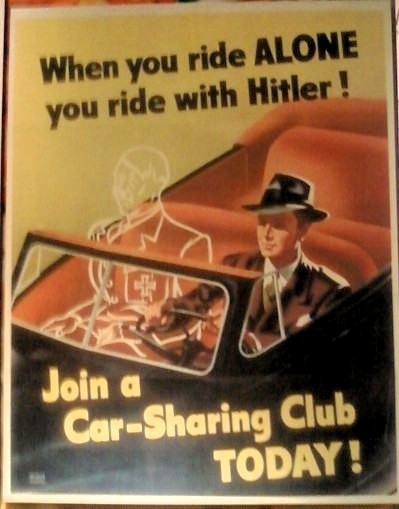
While visiting a museum I came across a poster from the time of the Second World War (see here). In it, a dashing man fully-formed sits in his cabriolet coupe next to the outline of Adolf Hitler. Across the top the poster reads: When you ride ALONE you ride with Hitler! Across the bottom it says: Join a Car-Sharing Club Today! In an age when the needs of the many tended to outweigh the needs of the few, when sacrifice and diligence and cooperation tended to trump convenience and wastefulness and selfishness, this poster probably have changed a few minds or convinced a handful of housewives to pool and conserve their resources. How, though, would such a poster work today? Would replacing Hitler with the outline of a religiously extremist Central Asian in turban and Kalashnikov (instead of the hardcore, genocidal Teuton in iron cross and side-part) convince today's Americans to understand that every gallon of Saudi Arabian gasoline they burn in their vehicles supports terrorism worldwide (see here & here)? I believe it is possible to win hearts and minds by using a slogan such as this: When you ride ALONE you finance Al Qaeda. I believe that if more people realized that America's addiction to combustible petrochemicals is her glaring, fatal Achilles heel, and if more people actively and consciously fought this addiction, we could move into a phase of human evolution marked not by death and pollution and destruction but by compassion and bounty and cooperation. So long, however, as we stay addicted to gasoline, as we keep driving alone, as we keep believing in the myth of American exceptionalism, as we keep voting for politicians who sell out to corporate interests, as we keep rejoicing at the subjugation and destruction of foreign lands by our military, and as we overdose on television we Ynki shall remain what we have become – a sea-anchor tearing apart the fragile structure of our common tender humanity. America delenda est.

© americanifesto / 場黑麥

12 December 2012

on self education

The modus operandi of many Americans I meet seems to be one of prideful ignorance. Rather than keeping their mouths shut on topics about which they know nothing, they will loudly proclaim their lack of knowledge and attempt to reduce their self-inflicted embarrassment by making eye contact with everyone present while laughing too hard and for too long. On the one hand, this destroys the flow of conversation amongst people-in-the-know; on the other hand, though, in some cases the ignorant party can learn something so that next time he might be a bit less clueless. (I believe that the 24-hour news cycle and its endless array of body-less blabbermouths has helped to convince people in this society that constant talking is a good thing; it is not, as it all too often keeps the mind from figuring things out, on its own, in peaceful contemplation.)

And yet here I sit, in this cold but sunny room, contributing to society's messiness by lamenting the fact that other people lament their lack of knowledge. What a confused mind I have, and what a high horse I ride. No amount of writing or blogging will change peoples' behavior; they do what they think is best for themselves because that is what everyone else is doing and if they don't, they feel like they might be missing out. And what, really, is the harm in someone voicing their curiosity and showing interest in things foreign to them, and strange? Perhaps they do it to stroke the egos of the people who have already taken the time to educate themselves about topics not directly related to their daily doings.

A few days ago, some graffiti came through on the tumblrbot, an image of a saying sprayed neatly onto a wall, which was: silence is better than bullshit. This is a simple yet powerful lesson. Over the last few months, I have attempted often to stick to this rule, only to fail in my effort to mind my own affairs when asked by other people what it is I do for a living, how my siblings are, or why I tie one of my pants-legs back with an reflective elastic cuff. Sometimes, I manage to keep quiet, but other times I let the words flow only to find myself saying more than I wanted to say and wishing that I were not expected to reveal the details of my personal business. In contemporary American society, individuals who sit quietly while in the company of others, who avoid constantly spilling their guts or gleefully joining in the boorish fun of tearing apart anything that anyone else says or does or implies, these persons are viewed as strange; they are soon avoided, mocked, and ostracized; they are, however, the very individuals who understand the crucial importance of inner peace and spiritual contentedness, who are continuously jettisoning extraneous belongings, feelings of honor or pride, and letting go of the last vestiges of this passings world. With that, I shall, for now, merge back into silence, and cease with this bullshit. Mahalo.

mentiri factorem fecit © 場黑麥

27 June 2012

on Sallust

I have recently finished reading a Latin-to-English translation from 1920 of the War with Catiline, by Sallust. (I had purchased the book for one dollar during a visit to my alma mater's library.) Beyond the fact that the actual war which this work purports to cover consumed no more than the last few pages of the text (which is scores of pages long), the tale deals primarily with such political corruption, societal decay, and moral downfall as that seems to have set the stage for Catiline's failed rebellion. Moreover, the situations Sallust describes in this book – situations which Catiline appears to have tried to exploit to his own benefit – struck me as eerily similar to situations we face in America, today.

Sallust speaks of the founding of Rome, how the city came to wealth and great fortune, becoming the mother of an empire. But, soon enough, the principles upon which it was founded – industriousness, thriftiness, valor – were supplanted by avarice, sloth, and self-aggrandizement. And, soon enough, in its primary political body, the Senate, “instead of modesty, incorruptibility, and honesty, shamelessness, bribery, and rapacity held sway.” This, I believe, is the trap into which our own Congress and Senate have fallen. The politicians who fill these bodies, while campaigning for election or reelection, champion themselves as honest persons of incorruptible and modest moral fiber only to revert, once they have gained office, to shamelessly selling their time and influence to the highest bidder and to writing such laws as rape the very people they have sworn to protect of their Lives, Liberty, and Property. Sallust speaks that when Rome had grown “great through toil and the practice of justice… savage tribes and mighty people subdued by force of arms… and all the seas and lands were open, then Fortune began to grow cruel and to bring confusion into all our affairs.” This text almost perfectly describes the course America charted from its founding until now, in that this nation was born in perilous circumstances, becoming soon a country dedicated to the preservation of the rule of law, then wiping out whole populations of First People tribes, and finally conquering Nazi Germany and Soviet Russia to leave land and sea our disposal, only to discover, as if we had but recently come to our senses, that our internal affairs were seriously – and perhaps irrevocably – out of alignment.

I am not the first to draw comparisons between the Roman and the American empires, and I am not the first to suggest the inevitability of an empire such as our own to fail, but I am delighted to have found an ancient work that so well supports these points. While there is much solid wisdom to be learned from past writers (I should like to suggest to persons in the Occupy and the Indignados movements to read the aforementioned book, and to prepare for a total lack of positive change), the primary lessons I gleaned from this interesting and worthwhile text are that life seems to follow certain paths inexorably, that politics are intolerably messy and best left alone, that money and influence always corrupt, that people should be trusted about as far as they can be thrown, and that elected officials will only reluctantly and with much kicking and screaming give up such power as to which they have become accustomed. So please, dear reader, fellow Second Sons of Liberty, comrades of the New Guards for our Future Security, please do not despair, for no matter how dark our times may seem, they are sure to get worse before they get better. Mahalo.

場黑麥 mentiri manufactorem fecit

work cited: Sallust, page 14, J. C. Rolfe, London: Heinemann; New York: Putnam's Sons, 1920

11 June 2012

on a SAR lost

Sons of the American Revolution; free-thinking, independent-minded citizens of America; fellow lovers of Liberty; dear few remaining self-sufficient, self-reliant Yankees:

We may have lost, once and for all, a member whom we once thought it possible to save. It was not enough that he allowed himself to be ruled by such fear as was being spoon-fed to the People in the immediate wake of the 9-11-2001 terrorist attacks. It was not enough that he jumped wholly onto the bandwagon of consumption-oriented market capitalism. It was not enough that he has stocked his home with delicate and costly things in direct violation of the teachings of frugality and compassion attributed to his god Jesus Christ. No, dear brothers of Freedom and sisters of Liberty, I have witnessed with my own eyes his full and complete retreat into madness, his obedient adoption of even the most trivial and poorly-thought-out drivel that tends to slither from the mouths of such politicians as Sarah Palin: he has replaced the compact fluorescent (CFL) bulbs with which he once reduced his energy consumption with old-school, incandescent bulbs. Also, he has learned from his wife that it is acceptable to leave the outside windows open for long periods of time while the air-conditioning is on full blast, thus proving to the world his nearly complete lack of self-critical thinking and his nearly total abandonment of the lessons of his childhood when making the little decisions that significantly impact not only his own life but also the wellbeing of every single other person alive today. Neither he nor his wife run surgical emergency operating rooms within the home, nor do they do much more with their eyes that use them to watch television (in this case, literally, the idiot-box); therefore, they do not require immediately-available light in order to save lives or to make the world a better place, only to guide their way from the couch to the refrigerator, and back again; (they therefore have no good reason to need the lights in their home to come to an immediately full brightness and can afford to wait a few moments for CFLs to gain full brightness). This our poor brother's mindset is so alien to our cause of personal hardiness and self-sufficient living, so devoid of hubris, so lacking in self-criticism as to have moved him so very close to the brink of the world of lost causes that I cannot see a way to save his soul from slowly rotting away, unused, inside the dank nether-regions of his unplumbed inner depths. We have lost him, dear siblings in Liberty: lost him to the hype; lost him to the Fear; lost him to the siren-call of false convenience; and lost him to such a mindset that tends to push this nation's problems down the road, kicking the can just far enough into the next generation's territory as to keep it out of sight without actually picking up the can and fucking recycling it.

I have tried speaking, I have tried reasoning, I have tried threats both open and thinly-veiled – all to no avail. Dear friends, fellow Sons and Daughters of the American Revolution, if anyone knows how to pull such a fellow as the man described above back from the abyss, back from his blind adherence to the poorly-conceived notions spewing from the suck-holes of our more radical politicians, please contact me or comment on this post, to assist me in my attempts to save this our sibling in Liberty. Please help me, oh dear friends, for I dance with despair, my heart near torn asunder. Mahalo.

場黑麥 menterefecterem fecit

15 December 2011

americansFIRST

I am hereby announcing a new nomenclature for all Americans, one that, by addressing the individual directly and his or her status as a member of this nation before addressing his or her race or skin color, will hopefully be a more equalizing and egalitarian form of address than the forms in use currently.

Instead of saying African-Americans, or referring to people whose skin color is somewhat darker than that of the majority as 'Black' let us refer to them as 'Americans of African descent.' Instead of saying 'Whites' let us refer to these people as Americans of European descent (their skin color is more pink than white, anyway). In cases where there are multiple origins of descent, let us say Americans of Mixed descent.

Since we Americans have a hard time abandoning completely the use of 'race' as a primary identifier, perhaps this new nomenclature can help smooth our transition to a more egalitarian coexistence.

Spes Mea In Ratio Est – 場黑麥 John Paul Roggenkamp